In October 2026, SAVIS and Soliton signed a cooperation agreement to jointly explore and evaluate integrated access security solutions based on the Zero Trust architecture (Zero Trust Access), towards proactive, reliable security and in line with the digital transformation requirements of businesses in the new era.
As the remote/hybrid work model becomes more and more popular, users can work from anywhere and on any device, the problem of access control, user authentication, devices, and resource protection becomes an important requirement in each organization’s information security strategy.
Grasping that need, SAVIS and Soliton – a leading technology enterprise in Japan, have officially cooperated to research, integrate and develop Access Security solutions based on the Zero Trust architecture (Zero Trust Access) for businesses and organizations in Vietnam and Japan.
Accordingly, the two sides will focus on exploiting strengths in the fields of digital identity, authentication, access management, device trust, security, and information security monitoring to form integrated security solution models, in which access is controlled based on identity, device status, trust level and security policies, instead of defaulting to trusting users or devices inside the network.
Combining SAVIS’ security and identity ecosystem with Soliton’s Zero Trust Access platform
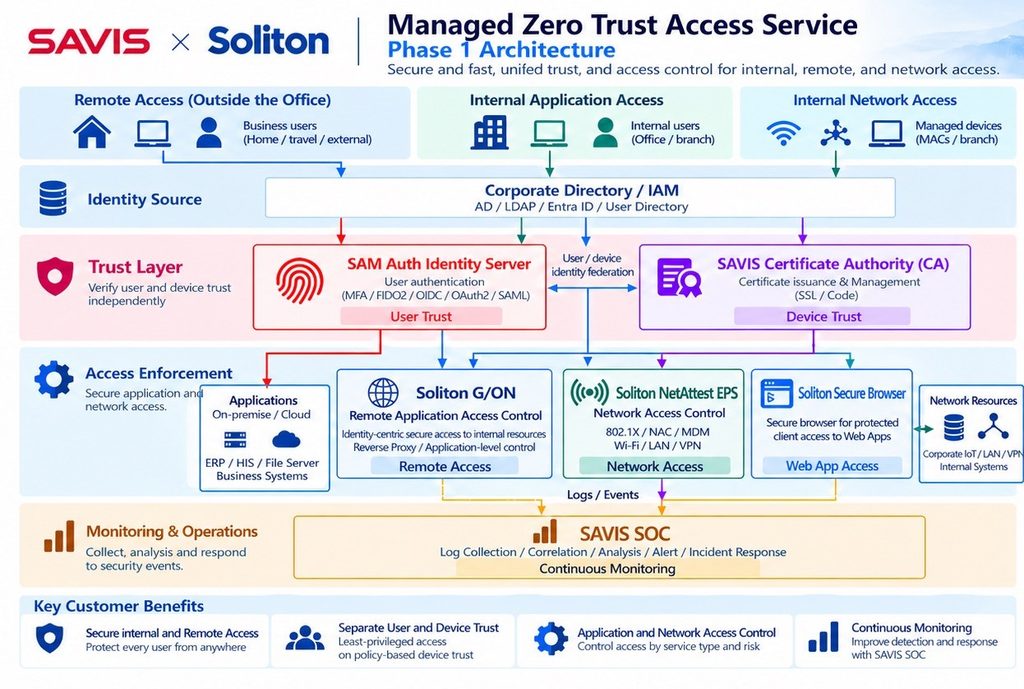
Within the framework of the cooperation, SAVIS plays a leading role in the integration and implementation of the solution in Vietnam, and provides technology components for identification, authentication, digital signatures and information security monitoring. The key components include:
- SAM FIDO2 Identity Server – Passwordless identification, authentication and encryption platform, supports MFA multi-factor authentication, Passkey/FIDO-based passwordless authentication, supports WebAuthn, CTAP 2.1 and CTAP 2.3…
- SAVIS Certificate Authority (CA) issues and manages digital certificates, serving identity authentication and establishing trust in the digital environment
- SAVIS SOC – Cybersecurity monitoring solution, allowing monitoring, detecting, warning and timely handling of information security risks and incidents
On the side of Soliton provides:
- Soliton G/On Remote Access Control
- Soliton NetAttest EPS Network Access Control
- Soliton SecureBrowser provides a secure browser environment for accessing protected web applications and resources
This combination creates a security architecture that extends from user and device identities to applications, networks, and information security monitoring.
In the first phase, the two sides aim to build a comprehensive access management service model (Managed Zero Trust Access Service) focusing on 4 main groups: remote access, internal application access, internal access and identity, user authentication through user trust, device trust, MFA/FIDO2 multi-factor authentication. This is the foundation to initially create a unified security ecosystem, where identity, strong authentication, device trust, access control, digital certificate-based security and security monitoring are connected in the same architecture. In particular, digital sovereign security based on the Zero Trust architecture (Sovereign Zero Trust) is identified as one of the potential cooperation directions, in line with the current trend in proactively controlling identity, data, infrastructure and access policies in the digital environment.
The cooperation between SAVIS and Soliton is a step forward to connect SAVIS’ Digital Trust capabilities with Soliton’s Zero Trust Access technology, towards a proactive, reliable security model that is suitable for the digital transformation requirements of businesses in the new era.